


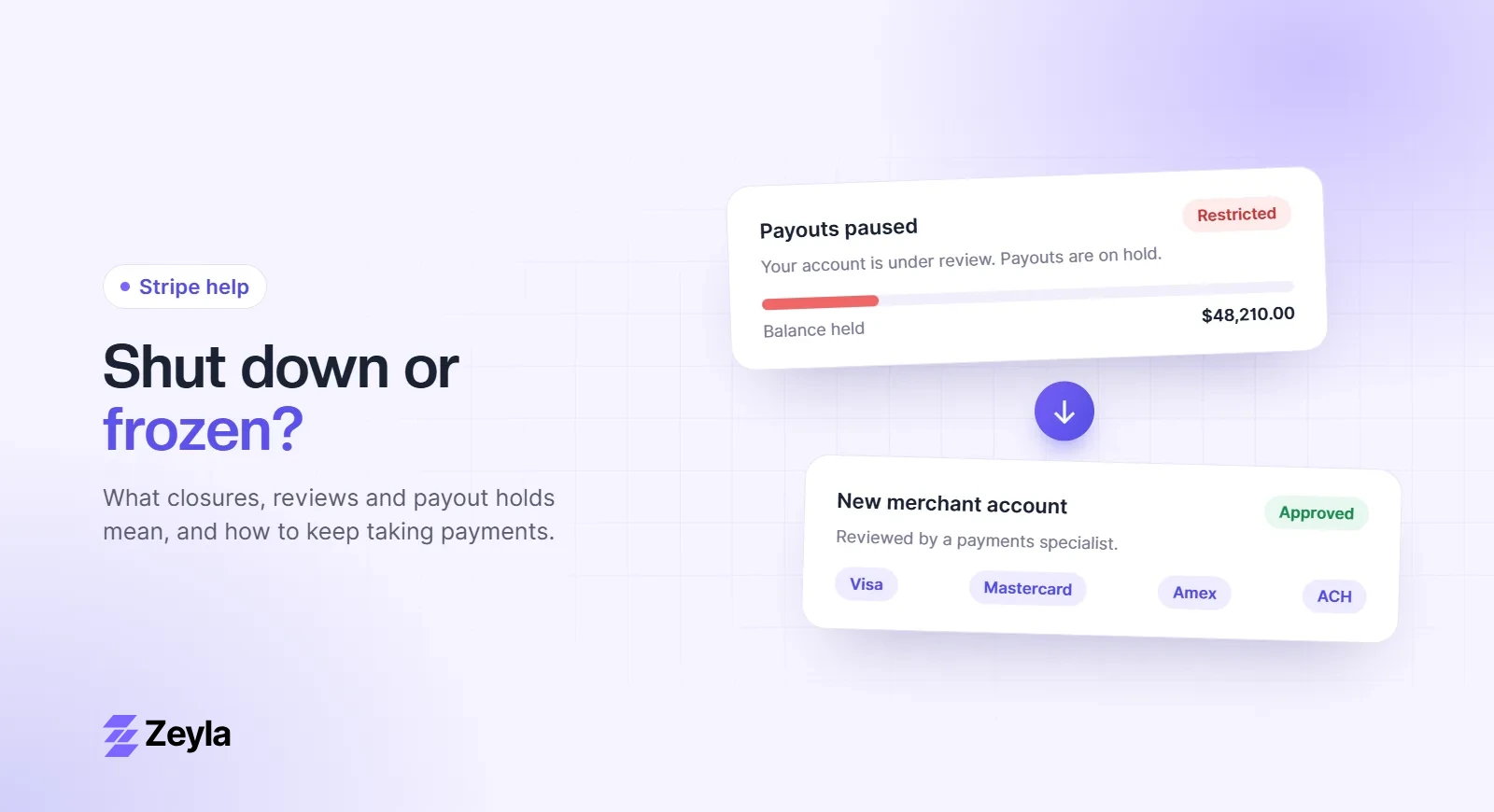
Stripe makes it easy to start accepting payments, often within minutes. That speed is also why so many accounts are closed later: approval happens first and the detailed review happens afterwards. Understanding what triggers a closure helps you prevent one, or decide whether Stripe is the right fit for your business at all.
Zeyla is an independent payment processing company and is not affiliated with Stripe, Inc.
Why fast sign-up leads to later closures
Stripe is a payment facilitator. Instead of underwriting each business in detail before it can take payments, it lets many businesses start straight away under its own merchant relationship and monitors them as they go. That works well for most low-risk businesses. For businesses in sensitive categories, the review that would have happened at application time happens later, sometimes after weeks of sales and a growing balance. Our guide to payment facilitators explains the model.
Reason 1: Your industry is restricted or prohibited
Stripe publishes a list of prohibited and restricted businesses. Some categories cannot use Stripe at all. Others need extra review or are only supported in certain forms. Categories that commonly lead to closures include:
- CBD and other hemp-derived products
- Supplements with strong claims, free trials or auto-ship
- Adult content and some adult services
- Firearms, ammunition and some accessories
- Vape, tobacco and kratom
- Many crypto and trading models
- Gambling, sweepstakes and some gaming models
- Debt collection and credit repair, and tech support
- Some travel and telemedicine models
Check Stripe's current list directly, because it changes. If your business is on it, the long-term fix is a provider that underwrites your category deliberately rather than an appeal.
Reason 2: Disputes, fraud and refunds
Card networks monitor dispute and fraud levels for every merchant, and processors are accountable for the merchants they serve. Visa's VAMP program, for example, counts fraud reports and disputes together. A rising chargeback ratio is one of the most common triggers for a review. Our guide to lowering your chargeback ratio covers prevention, and the calculator shows where you stand.
Reason 3: Sudden changes
- Volume jumping far above your usual level
- Much larger order sizes
- New products, a new website or a new business model
- Customers from new countries
None of these is wrong, but unexplained changes look like risk to automated systems. If you can, tell your provider before a launch or big promotion.
Reason 4: Future delivery
When customers pay long before they receive anything, such as pre-orders, events, travel or annual plans, the provider carries the risk that delivery won't happen. That exposure can trigger a hold or closure, especially if it grows quickly.
Reason 5: Verification and mismatched information
Accounts can be restricted when details don't line up: a business name that differs from the website, an owner who can't be verified, or a bank account in a different name. These are usually the easiest problems to fix. See Stripe account under review: what it means.
Is Stripe the right fit for your business?
For many businesses, yes. For businesses in restricted categories, or with naturally higher dispute rates, a dedicated high-risk merchant account can be the more stable choice. The difference is that the review happens up front: you know your terms, any reserve and any limits before you take your first payment, instead of discovering them in a closure notice.
Not sure where you stand? Take our 1-minute high-risk quiz, read our Stripe alternative page, or if Stripe has already closed your account, start with Stripe shut down my account: what to do next.
Zeyla reviews every application personally. Apply in about 3 minutes.