


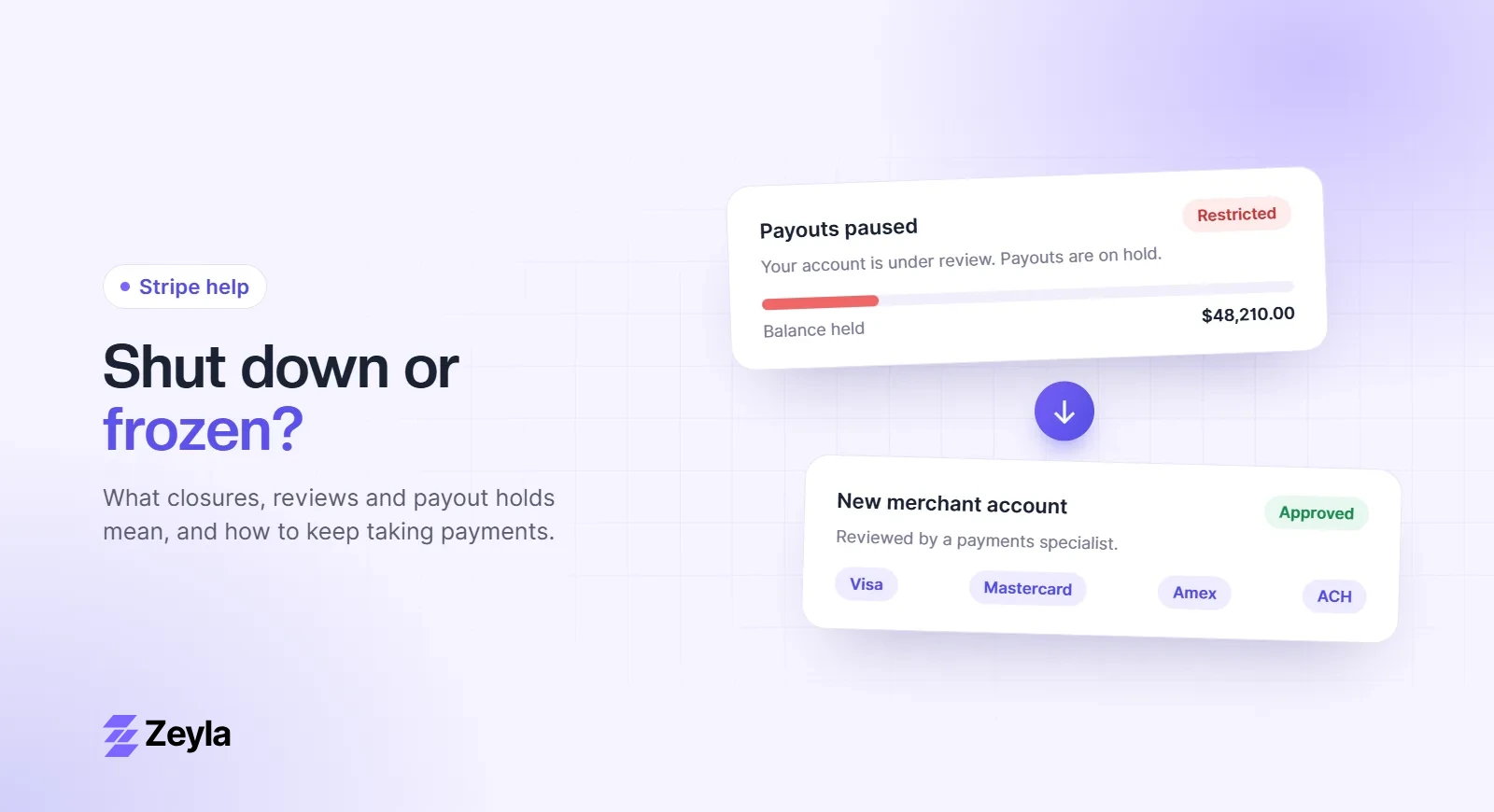
If Stripe has paused your payouts after a risk review, you have probably seen a reference to 120 days. That number frightens a lot of business owners, so it helps to understand exactly what it means, why it exists and what you can do to get as much of your money back as possible.
Zeyla is an independent payment processing company and is not affiliated with Stripe, Inc. This article summarises Stripe's published Unacceptable Risk Policy and general card industry practice. Always check the specific notice you received.
What the 120-day hold is
Stripe's policy says that when it identifies risk it considers unacceptable, payouts are typically paused for 120 days from the initial notice. The held balance acts as a buffer against money that may still flow back out of your account: refunds you issue, disputes customers file and chargebacks you lose.
At the end of the period Stripe carries out a formal review. Depending on what happened during those months, it may:
- Release all or part of the remaining balance to you
- Continue holding all or part of it
- Cancel the payout, where risk continues or the law requires it
Stripe says held funds are kept separate from its own funds and that it will notify you by email if payouts are delayed or cancelled.
Why 120 days?
Customers can dispute a card payment for months after the purchase. For most dispute reasons the card networks allow a window of around 120 days from the transaction or from the expected delivery date, and some reasons allow longer. A processor that pays out your whole balance immediately would carry the cost of every dispute filed after your account closed. The hold lets it wait until most of that risk has passed.
That is also why businesses that deliver in the future, such as travel, events, pre-orders or annual subscriptions, often see longer holds: the dispute window doesn't start until the service is due.
How a hold differs from a reserve
A hold pauses the whole balance while an account is reviewed or wound down. A rolling reserve holds a percentage of each day's sales for a set period while the account stays open, releasing each day's portion when its period ends. Many high-risk merchant accounts use a reserve from the start instead of approving everyone and freezing funds later. The rolling reserve calculator shows how a reserve affects cash flow, and our guide to payment holds and reserves covers both in more detail.
How to get as much of your money back as possible
- Refund rather than fight when a customer clearly deserves one. A refund costs only the sale. A lost chargeback costs the sale plus a fee and counts against you.
- Respond to every dispute with evidence: receipts, tracking, delivery confirmation, login records, communications and your accepted terms.
- Fulfil outstanding orders. Customers who receive what they paid for rarely dispute.
- Keep communicating. Tell customers how to reach you. Many disputes start because a customer couldn't get an answer.
- Appeal if there's a real case. If the decision was based on missing information or a misunderstanding, an appeal may shorten the process. See how to appeal a Stripe account closure.
- Keep records of every notice, date and message in case you need to escalate later.
Can you get funds released early?
Sometimes, but there is no guaranteed route. Early release is most likely when you can show the risk is lower than it looked: disputes have been resolved, orders have been delivered, or the trigger was a one-off. Ask politely, provide documents, and don't open multiple tickets saying the same thing.
If you believe funds are being held beyond what your agreement allows, your Stripe services agreement explains how disputes with Stripe are handled. For a significant amount, it may be worth talking to a lawyer about your options.
Keep cash flowing in the meantime
Four months is a long time to run a business without income. Most merchants in this position open a new merchant account while the hold runs its course:
- Export your Stripe transaction history and statements while you have access.
- Apply with a provider that underwrites your industry, and tell them about the hold up front.
- Expect the new account to have sensible protections of its own, such as a modest reserve or volume limits at first.
- Switch your checkout and descriptor in one move. See how to switch payment processors.
For the bigger picture, read Stripe shut down my account: what to do next.
Talk to a specialist
Zeyla reviews every application personally, including businesses whose funds are currently held by another provider. A payments specialist will tell you plainly what terms are realistic for your business. Applying is free and takes about 3 minutes.
Apply in about 3 minutes or see our Stripe alternative for high-risk businesses.