

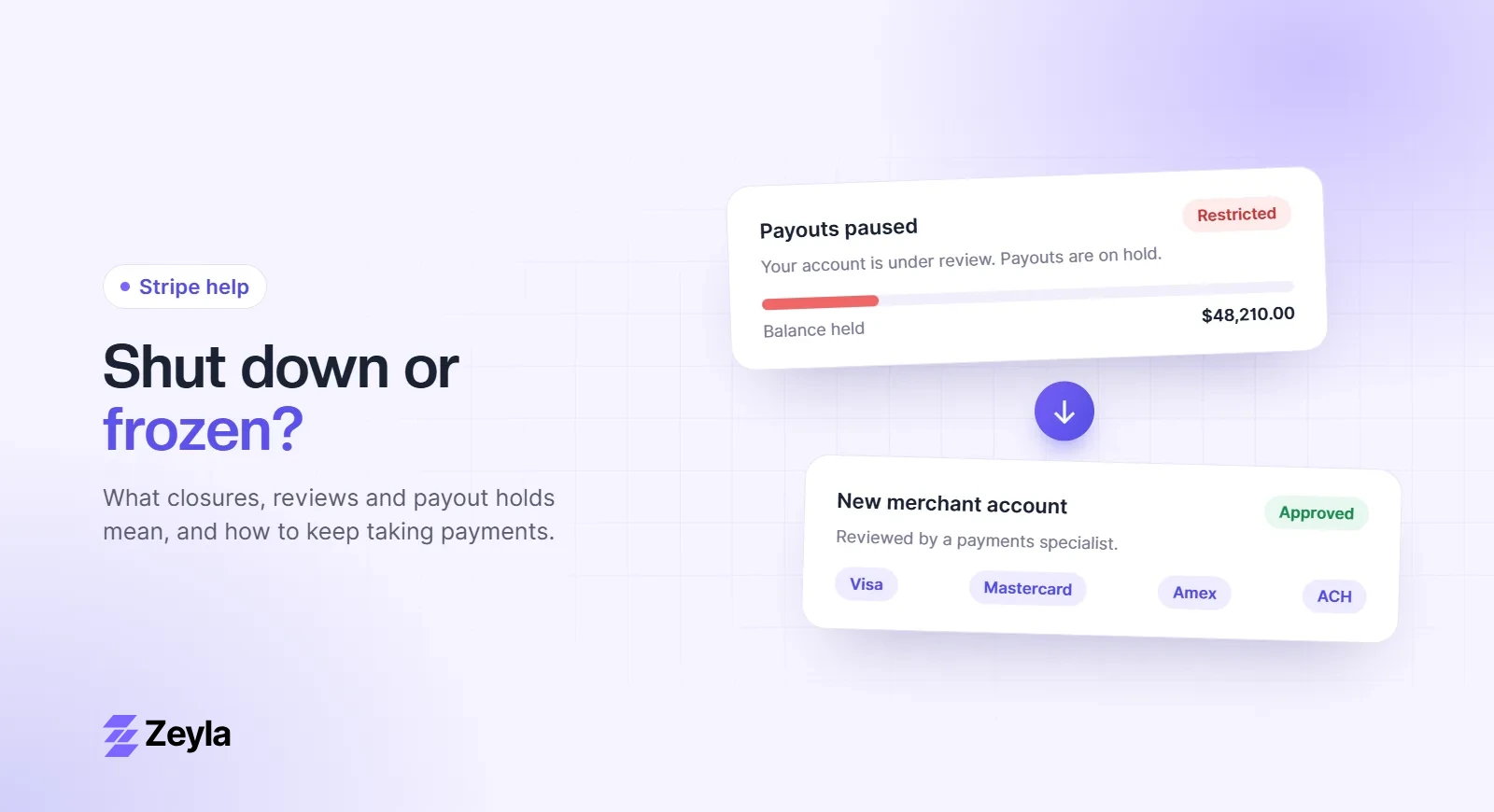
A reserve means Stripe is holding back part of your balance as a safety net against future refunds and disputes. Your account is still open and you can still take payments, but less cash reaches your bank for a while. Here's how it works and what you can do about it.
Zeyla is an independent payment processing company and is not affiliated with Stripe, Inc.
The main types of reserve
- Rolling reserve: a percentage of each day's sales is held for a set number of days, then released. New sales keep replacing old ones, so a balance builds up and then levels off.
- Fixed reserve: a set amount, or a share of your balance, is held until Stripe reviews the account again.
- Payout delay: your payout schedule is lengthened, so money takes longer to arrive.
See exactly how much would be held with our rolling reserve calculator.
Why Stripe adds reserves
- You sell something that's paid for long before it's delivered, such as pre-orders, events, travel or annual plans.
- Your dispute or refund rate has risen.
- Your volume or average order size has jumped.
- You're in an industry Stripe sees as higher risk.
- Your account is new and has little history.
How to get a reserve reduced or removed
- Ask what will change it. Ask support which numbers or documents would lead to a review.
- Show your delivery times. If customers get what they paid for quickly, provide shipping or fulfilment records to prove it.
- Lower disputes and refunds. A few months of clean numbers is the strongest argument. Our chargeback guide shows how.
- Share your finances. Bank statements or financials that show you can cover refunds can reassure a risk team.
Our guide on getting a rolling reserve reduced or released covers this in more detail, and applies to any provider.
Is a reserve a warning sign?
Not always. Reserves are a normal part of payment processing for many businesses, and an agreed reserve is far better than a closure. But if a reserve appears suddenly alongside requests for information, treat it as a sign that your account is being watched closely. Read what an account review means.
Frequently asked questions
Will I get my reserve money back?
Yes, reserved funds are yours. They're released on the schedule Stripe sets, minus any refunds, disputes or fees they're used to cover.
Can I move to another provider to avoid a reserve?
Many high-risk providers also use reserves. The difference is that a specialist provider agrees the reserve with you before you start, so it doesn't appear without warning.
Prefer terms agreed up front?
Zeyla explains any reserve in writing before you sign, including the percentage, hold period and review date. Apply in about 3 minutes.